
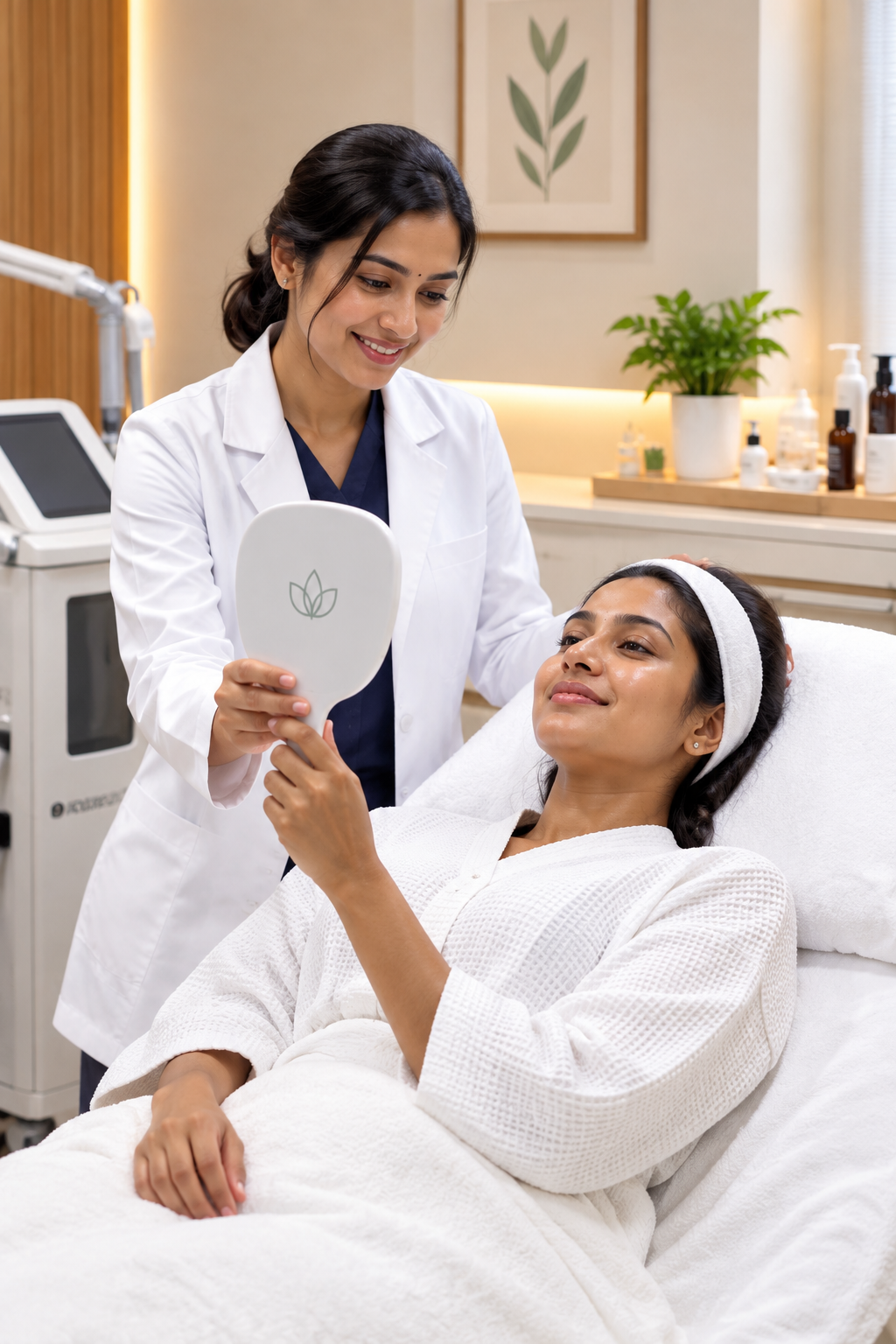
Cosmetology at AURA focuses on specific skin, hair, and aesthetic concerns through personalized, in-clinic procedures rather than one-size-fits-all treatments. From acne scars and skin growths to hair thinning and selected skin procedures, every concern is assessed before a treatment is recommended.
Every patient responds differently to cosmetic procedures, which is why treatment is planned around the individual's skin type, concern, sensitivity, and treatment goals. Depending on the condition, AURA offers procedures including acne scar treatment, cyst excision, electro cautery, PRP/GFC injections, RF cautery, skin biopsy, and cryo surgery.
The aim is not simply to treat the visible concern, but to select an appropriate procedure based on what the skin or hair actually needs.
Explore each cosmetology procedure and understand how it works, its benefits, and what to expect.
Acne Scar Treatment is a combination of procedures designed to improve depressed and uneven skin texture left behind after acne heals. Acne can damage the skin's collagen structure, creating different types of scars that often do not improve significantly with skincare products alone.
The first step is identifying the type and pattern of scarring. Ice-pick, boxcar, and rolling scars have different structures and may respond better to different techniques. Depending on the scar type, treatment may include TCA CROSS, subcision, microneedling, or dermal fillers. When several scar types are present, a combination approach may be recommended.
Treatment selected according to individual scar type and pattern
Helps improve the appearance of depressed and uneven acne scars
Combination approaches can address different types of scarring
Supports gradual collagen remodeling and skin texture improvement
Structured treatment plans allow progress to be assessed over time
Your acne scars are examined closely to identify their type, depth, distribution, and overall skin condition.
The appropriate technique, such as TCA CROSS, subcision, microneedling, or dermal fillers, is selected according to your scar pattern.
The selected procedure is performed in-clinic, with the treatment approach and intensity adjusted to your individual needs.
Your progress is reviewed between sessions and the treatment plan is adjusted when needed. Multiple sessions may be recommended depending on the severity and type of scarring.
A cyst is a closed sac that develops beneath the skin and may contain keratin, fluid, or other material. Epidermoid cysts are among the common types of skin cysts. They may remain small and painless, or become larger, inflamed, tender, or repeatedly return.
Simply draining a cyst may provide temporary relief, but the cyst can recur if its surrounding sac or wall remains. Cyst excision involves carefully removing the cyst and, when appropriate, its complete sac under local anesthesia. The approach depends on the cyst's size, location, condition, and whether it is inflamed at the time of treatment.
Removes the cyst and its sac when complete excision is appropriate
Helps reduce the chance of the cyst returning
Performed as an outpatient procedure under local anesthesia
Treatment is planned according to the cyst's size and location
Provides appropriate wound-care guidance during healing
The cyst is examined to assess its size, location, depth, and characteristics before treatment is recommended.
The appropriate excision approach is selected, including whether complete removal is suitable at that time.
The area is numbed with local anesthesia and the cyst is carefully removed through a controlled procedure.
Wound-care instructions are provided, with follow-up arranged when required for healing assessment or stitch removal.
Electro cautery is an in-clinic procedure that uses controlled heat to remove selected small skin growths, including skin tags, warts, and certain benign lesions such as seborrheic keratosis. The heat treats the targeted tissue while helping control minor bleeding during the procedure.
The growth is examined first to determine whether electro cautery is appropriate. Not every skin growth should be removed with cautery, and lesions with unusual or atypical features may require further evaluation or biopsy before treatment. When cautery is suitable, the area is treated under local anesthesia and the growth is carefully removed.
Precise treatment of selected small skin growths
Usually does not require stitches
Local anesthesia helps keep the procedure comfortable
Quick in-clinic treatment for suitable lesions
Appropriate assessment before removal
The growth is examined to assess its appearance and determine whether cautery is suitable.
The treatment approach is selected according to the growth's type, size, and location.
The area is numbed with local anesthesia and the selected growth is carefully treated using controlled heat.
Guidance is provided on keeping the treated area clean and allowing the scab to heal naturally without picking.
PRP (Platelet-Rich Plasma) and GFC (Growth Factor Concentrate) are injection-based treatments used for selected cases of hair thinning and hair fall. PRP is prepared from a small sample of the patient's own blood and processed to concentrate platelets and growth factors before being injected into the scalp.
GFC is a growth-factor-based preparation derived from the patient's blood and is designed to deliver concentrated growth factors to the scalp. The appropriate option depends on the individual's hair-loss pattern, scalp condition, and follicle health. Hair fall can have several contributing factors, including genetic, hormonal, nutritional, and lifestyle-related causes. A scalp and hair assessment is therefore performed first, and blood tests may be recommended when nutritional or hormonal factors need to be evaluated.
Uses the patient's own blood-derived material
Targets the scalp rather than treating hair fall only at the surface
May support healthier hair growth in suitable cases
PRP and GFC options can be selected according to individual needs
Treatment can be planned around the patient's hair-loss pattern and response
Scalp condition, hair density, and the pattern of hair loss are assessed before treatment.
PRP or GFC is selected based on the individual's scalp and hair condition.
A small blood sample is collected, processed, and the prepared treatment is injected into selected areas of the scalp.
Progress is monitored during follow-up, with additional sessions recommended when appropriate.
Radio Frequency (RF) Cautery uses controlled radio-frequency energy to treat selected skin growths with precision. The energy is applied to the targeted tissue in a controlled manner, making the procedure suitable for certain small growths and areas where careful treatment is important.
The growth is assessed first to determine whether RF cautery is appropriate. Factors such as its appearance, size, location, and characteristics are considered before treatment. When suitable, the procedure is performed with controlled energy application to the targeted area while taking care to limit unnecessary treatment of the surrounding skin.
Controlled treatment of selected skin growths
Precise application of radio-frequency energy
Suitable for certain cosmetically sensitive areas
Usually does not require stitches
Treatment approach can be adjusted according to the growth and location
The growth is examined to determine whether RF cautery is appropriate for the area.
Energy settings and treatment approach are selected according to the growth's characteristics and location.
Controlled RF energy is applied to treat the targeted tissue.
Aftercare guidance is provided to support healing and protect the treated area.
A skin biopsy is a diagnostic procedure in which a small sample of skin tissue is removed and sent for laboratory examination, known as histopathology. It may be recommended when a mole, rash, growth, or other skin lesion has unusual features or cannot be confidently diagnosed through examination alone.
A biopsy helps provide a clearer understanding of what is causing the skin change and can guide the next step in management. Depending on the lesion and clinical assessment, the sample may be taken from a small portion of the lesion or the entire lesion may be removed.
Provides laboratory-based information about the skin lesion
Helps clarify the nature of unusual or unexplained skin changes
Supports appropriate treatment planning
Performed under local anesthesia for patient comfort
Helps avoid treating an uncertain lesion without a proper diagnosis
The lesion is examined and its appearance, location, and characteristics are assessed.
The appropriate biopsy method is selected based on the lesion and the diagnostic requirement.
A small tissue sample is removed under local anesthesia and sent for histopathological examination.
The results are reviewed to determine the appropriate next step, which may include monitoring, further treatment, or additional evaluation.
01
Personalized treatment based on your specific skin or hair
concern.
02
Procedures selected according to skin type, sensitivity,
and individual needs.
03
Professional in-clinic treatments rather than a
one-size-fits-all approach.
04
Multiple treatment options for different skin, hair, and
aesthetic concerns.
05
Clear treatment guidance and realistic expectations before
starting.
Your skin, hair, or aesthetic concern is discussed and examined before any procedure is recommended.
Your skin type, sensitivity, severity of the concern, and treatment requirements are evaluated to identify the most appropriate approach.
A suitable cosmetology procedure is selected and performed according to your individual concern and treatment plan.
Your response to treatment is reviewed during follow-up, with further sessions or adjustments recommended when appropriate.
Not sure which cosmetology treatment is right for your skin or hair concern? Get a personalized assessment first.
Book AppointmentCall 96007 71240The right treatment depends on your specific concern, skin or hair condition, and individual requirements. An assessment is carried out before a procedure is recommended.
AURA offers acne scar treatment, cyst excision, electro cautery, PRP/GFC injections, RF cautery, skin biopsy, and cryo surgery for selected concerns.
Treatment intensity and technique can be selected according to individual skin sensitivity. Your skin is assessed before the appropriate procedure is recommended.
Depending on the condition, different procedures may be recommended as part of an individualized treatment plan. The combination depends on the specific concern and treatment response.
The number of sessions varies depending on the procedure and the concern being treated. This can be discussed during your consultation.
Pre- and post-treatment care depends on the procedure. You will receive specific guidance based on the treatment selected for your skin or hair concern.